The 2026 First-Party Data & High-Intent Funnel Blueprint

It’s the first Tuesday of 2026. You open your lead generation dashboard, bracing yourself.
Remember the good old days of 2023? You could drop a pixel on a website, follow someone around Meta for three months with retargeting ads, buy a list of third-party consumer behaviors, and have a steady stream of “leads” for $30 a pop.
In 2026, that dashboard looks different. Cookie deprecation is no longer a “future threat”; it is the settled reality of the internet. Global privacy regulations have shut down the Wild West of data rentals. Ad platforms like Google and Meta now operate in a semi-blind environment, struggling with “signal loss.”
If your service business whether you manage a specialized dental clinic, run a commercial HVAC operation, or lead a B2B consultancy is still trying to run the 2023 playbook, your dashboard isn’t just looking thin. It is looking expensive.
Your Customer Acquisition Cost (CAC) has likely doubled. The leads that do trickle through are often unqualified tire-kickers. The “ads don’t convert” argument is louder than ever.
But look at the top-performing brands in your space. They aren’t panicking. They seem to have a private spigot of high-quality leads that their sales teams actually love calling. They aren’t guessing who might need their services; they know exactly who needs them, why they need them, and when they are ready to buy.
What is their secret? It isn’t magic. It is infrastructure. They spent the last two years executing the definitive playbook for the new internet: First-Party Data combined with High-Intent Funnels.
At Entrustech Inc., we have spent years guiding healthcare providers, trade companies, and local service brands through this technical shift. We don’t just buy ads; we build modern client acquisition engines. Here is your definitive blueprint for generating qualified leads without cookie tracking in 2026.
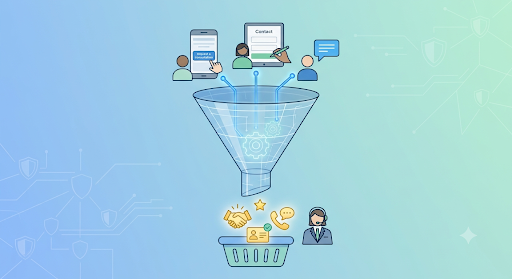
To understand the solution, you must fully confront why the old way is dead. Digital marketing historically operated on “Borrowed Data.”
You paid Meta or Google a fee to access their sophisticated tracking data. You relied on their ability to see that a user visited five roofing websites and therefore was a “high-intent” roofer lead.
Today, that entire system is optimized for Signal Loss. Privacy updates (like Apple’s ATT and Google’s own browser controls) mean ad platforms only see a tiny fraction of a user’s offline journey. Google Max or Meta Advantage campaigns are powerful AI tools, but they are only as smart as the data you feed them. If you feed them weak signals (like simple page views), they will generate weak leads.
Borrowed data has become a low-yield, high-cost commodity. In 2026, the only data asset with appreciating value is the data you Own.
To build your owned data asset, you must fundamentally upgrade your website layout from a passive brochure to an interactive value exchange engine. You must replace the boring, frictionless “Contact Us” page (as we discussed in our previous blog topic) with a compelling lead capture layer.
Nobody is giving you their phone number in exchange for a “newsletter subscription” anymore. Today, you must offer immediate, personalized value in exchange for zero-party data.
Blueprint Tweak: The Leveled Lead Magnet
Swap generic PDF downloads for interactive tools:
By guiding prospects through these simple visual flows, you deliver instant value (an estimate, a diagnosis, or an audit) while capturing deep qualification data that helps you separate $200 inquiries from $20,000 contract opportunities.
You cannot rely on simple browser-based pixels (like GTM or Meta’s old tracking script). They are now easily blocked. In 2026, all conversion signals must be fired Server-to-Server.
You must connect your CRM directly to Google Ads and Meta’s Conversions API (CAPI). When a lead advances from “appointment set” to “contract signed” in your internal system, your server automatically notifies the ad platform. This tells the ad algorithm exactly what a profitable customer looks like, lowering your acquisition costs while your competitors are still optimizing for weak website clicks.
Capturing data is only half the battle. Now you must act on it instantly based on the intent signal you just collected.
A “High-Intent Funnel” is a deliberate sequence of multi-channel touches tailored specifically to where a prospect is in their buyer’s journey. It moves beyond generic email blasts and utilizes targeted segmenting.
When that plumbing lead identifies as “commercial” and “urgent,” they do not go into the same email list as the homeowner looking for faucet ideas. They receive a completely different path.
As we analyzed in our topic breakdown, you must respond to a high-intent lead in under 5 minutes. If they interacted with your “urgent” funnel, your system must send an automated, human-sounding SMS within 60 seconds:
”Hi [First Name], received your diagnostic quiz. My commercial team is standing by to help can we connect via phone right now or should we send a tech to [Zip Code]?”
For prospects who entered the funnel at a lower intent stage (e.g., they downloaded the “B2B Audit Checklist”), the funnel nurturing must react to their behavior:
Building a robust first-party data infrastructure, integrating server-side API tracking, creating visual multi-channel funnels, and managing automated nurture sequences requires specialized skills in technology, psychology, copywriting, design, and analytics.
Trying to manage all of this internally while running your business operations is operations overwhelm. Most business owners end up with a fragmented stack of disconnected tools and wasted ad spend.
At Entrustech Inc., we take the entire burden off your shoulders. We are a full-service, “done-for-you” digital marketing agency based in East Brunswick, NJ.
We don’t just buy ads and show you generic reports. We build modernized client acquisition engines. We architect the customized high-intent funnels, configure the server-side technical tracking, create compelling motion graphics and copy, and synchronize your entire lead pipeline from targeted ad click to booked appointment and signed contract.
We act as your complete senior marketing team, allowing you to stop worrying about algorithm shifts and focus entirely on serving your growing list of high-value clients.
Is your business ready for the cookieless future?
Claim your Free $500 Website & Marketing Blueprint Audit today. Our NJ team will analyze your current data setup, identify conversion leaks, and build a customized 2026 data strategy.
First-party data is information you collect directly from your audience through interactions on your own web properties, CRM, purchase history, and email list (e.g., pages visited, leads forms filled, appointments booked). It is crucial in 2026 because traditional third-party tracking cookies are obsolete. Owning accurate data allows you to measure true conversion value, comply with privacy laws, and feed hyper-accurate optimization signals back to ad platforms like Google Ads and Meta.
They lower CAC in two primary ways. First, by using zero-party data to pre-qualify leads inside the funnel, you waste less on irrelevant ad clicks from unqualified buyers. Second, by feeding verified conversion milestones (like "booked call" rather than "site visit") back to ad engines via APIs, the ad algorithms optimize for profitable buyers, significantly improving targeting accuracy and ROAS.
Zero-party data is information a customer intentionally and proactively shares with you such as specific problem diagnoses, intended timelines, service preferences, and budgets. High-intent funnels use this stated data to immediately segment prospects. Instead of a generic follow-up, a lead who stated "urgent help needed" receives an instant SMS, while a lead who selected "researching options" receives an automated education sequence.
TIMELINES vary depending on site complexity and data migration needs. Initial technical setup (including server-side API integration, new landing page design, and CRM connection) typically takes 4 to 6 weeks. Paid ad campaigns connected to these funnels generate traffic and leads almost immediately upon launch, with significant optimization and ROI maturity typically seen in 3 to 6 months.
Absolutely. High-intent funnels are extremely efficient for local service providers because they eliminate ad budget bleed. Local plumbers, HVAC teams, or dental practices can focus on long-tail, hyper-local keywords and use simple, visual quizzes to capture deep qualification data. They don't need national budgets; they just need highly efficient conversion mechanisms in their specific territories.
Managing technical API configurations, designing conversion-optimized web wireframes, copywriting persuasive nurture sequences, designing motion graphic assets, and synthesizing complex cross-platform data requires a highly specialized multi-disciplinary team. Entrustech provides an entire senior-level marketing department at a fraction of the cost of one in-house senior hire all focused strictly on metrics that grow your bottom line, on flexible month-to-month service terms.
WhatsApp us