Critical PHP Vulnerabilities in 2026: What Website Owners Must Do Now

xAI dropped Grok 4.6 on August 12, 2026. The headline is not simply “another smarter model.” It is a serious push toward long-running agents, coding, visual application building and lower-cost knowledge work.
One day after xAI introduced Grok Bot, the company made another move: Grok 4.6. Released on August 12, 2026, the model is positioned as xAI’s frontier model for coding, agentic work and knowledge tasks. The bigger story is where xAI says it improved: staying on complex jobs for many steps, researching unfamiliar subjects, working across codebases, and turning broad ideas into polished applications or work artifacts.
That puts Grok 4.6 directly into the territory where Anthropic’s Claude Fable 5 has built its reputation. Fable 5 is Anthropic’s most capable widely released model and was designed for demanding reasoning and long-horizon agentic work. It also comes with a 1 million-token context window and a much higher API price.
So which is the better model? The useful answer is not “Grok” or “Claude.” It depends on what you are trying to get done, how long the task runs, how much context you need, how sensitive you are to cost, and how much you value Fable 5’s extra capability on the hardest workloads.
Grok 4.6 arrives less than a month after Grok 4.5, but this is more than a minor naming update. xAI says the new model received a longer supplemental training run, with curated model-generated reasoning data, engineering data, improved training techniques, supervised fine-tuning trajectories regenerated with Grok 4.5, and reinforcement learning across agentic tasks.
The practical focus is long-running work. That matters because many real business tasks are not one-prompt questions. A useful AI agent may need to inspect information, decide what to do next, call a tool, evaluate the result, recover from an error, update a document, and then keep going.
xAI specifically highlights work across software engineering, STEM, web development, computer-aided design and general knowledge work. It also says Grok 4.6 showed more self-testing and verification on longer trajectories. That is exactly the direction enterprise AI is moving: away from chatbots that answer and toward systems that complete workflows.
Entrustech can help businesses identify repetitive workflows where AI agents and automation can save time without adding unnecessary complexity.
This is the main upgrade. Grok 4.6 is designed to stay with a job across many steps. For a developer, that could mean exploring a codebase, implementing a feature, testing it and fixing failures. For a business analyst, it could mean researching a market, organizing findings and building a presentation or working model.
xAI continues to make coding a major part of the Grok product story. Grok 4.6 is the default model in Grok Build and is available in Cursor. The company says the model is stronger at turning broad product ideas into working first versions and at creating more ambitious visual and interactive projects.
That is worth watching for non-developers too. “Vibe coding” is quickly becoming a business capability. A marketing team may use an AI coding agent to build an internal calculator. An operations team might prototype a dashboard. A salesperson could create a lightweight lead qualification tool without waiting for a full software project.
The API supports text and image input with text output. That allows the model to reason over screenshots, diagrams, interfaces and other visual information as part of a broader task. xAI’s launch announcement puts particular emphasis on better first passes for visual and interactive application work.
According to xAI’s developer documentation, Grok 4.6 supports function calling, web search, X search and code execution. These tools matter because agents need more than language generation. Search gives them current information, code execution helps them calculate and transform data, and function calls let them act inside business systems.
Developers can choose low, medium, high or xhigh reasoning effort. That makes it possible to trade speed and cost against depth. A quick classification task should not need the same amount of reasoning as a difficult software migration or a complex research job.
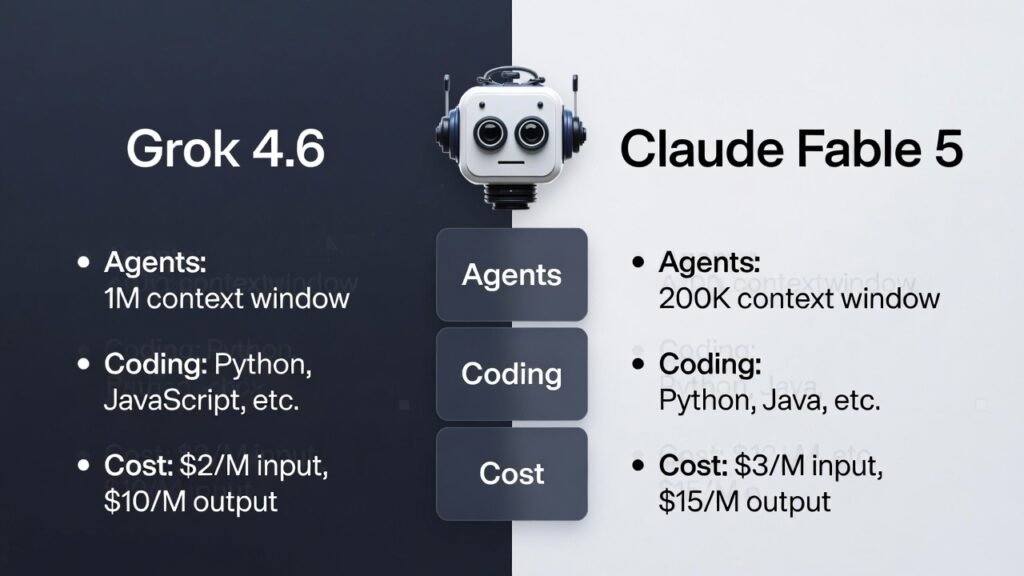
For API use, Grok 4.6 starts at $2 per million input tokens and $6 per million output tokens. xAI also offers a fast variant at twice the price, which implies $4 per million input tokens and $12 per million output tokens at the published base rates.
The model has a 500,000-token context window. xAI lists no text output limit in the model overview, although real deployments are still subject to practical API, rate-limit and account constraints.
A simple cost example: If an application used 10 million input tokens and generated 2 million output tokens in a month, the base Grok 4.6 token cost would be about $32 before any additional tool, caching or infrastructure charges. At Fable 5’s published rates, the same raw token volume would be about $200. Token count is not the same as completed-task cost, but the difference is large enough to matter for high-volume workflows.
For companies evaluating AI at scale, this pricing may be Grok 4.6’s biggest strategic advantage. A model that is slightly behind on some frontier benchmarks can still be the better operational choice if it performs the task well enough at a fraction of the cost.
Anthropic released Claude Fable 5 in June 2026 as its most capable broadly available model. It is built for difficult reasoning, long-running agents, software engineering, knowledge work, vision and scientific research. Anthropic describes it as a “Mythos-class” model made safe for general use.
Fable 5 has a 1 million-token context window, twice Grok 4.6’s published context size, and supports up to 128,000 output tokens per request. It uses always-on adaptive thinking. Developers can control effort, but they cannot disable thinking entirely.
Its API pricing is $10 per million input tokens and $50 per million output tokens. That makes Fable 5 five times more expensive on input and a little over eight times more expensive on output than base Grok 4.6.
There is another important difference: Fable 5 uses safety classifiers that can refuse certain requests. Anthropic documents fallback mechanisms for developers when a request is declined. It also requires 30-day data retention for Fable 5 and does not offer zero-data-retention access for the model. For organizations with strict data policies, that needs to be evaluated before deployment.
Best fit: cost-sensitive agentic workflows, coding, interactive builds, high-volume automation and teams already using Grok Build or Cursor.
Best fit: highest-difficulty long-horizon work, very large context, advanced analysis, vision-heavy reasoning and workloads where incremental capability is worth the premium.
| Category | Grok 4.6 | Claude Fable 5 |
|---|---|---|
| API input price | $2 / 1M tokens | $10 / 1M tokens |
| API output price | $6 / 1M tokens | $50 / 1M tokens |
| Context window | 500K tokens | 1M tokens |
| Max output | xAI lists no text output limit | Up to 128K tokens |
| Reasoning control | Low, medium, high, xhigh | Adaptive thinking always on; effort control |
| Agentic focus | Long-running agents, coding, research, interactive work | Long-horizon agents, coding, knowledge work, vision |
| Tooling | Function calling, web search, X search, code execution | Code execution, memory, programmatic tool calling, compaction, vision and other Claude platform tools |
| Safety behavior | Improved safeguards calibrated to model capability | Safety classifiers can refuse some requests; fallback supported |
| Data retention note | Check xAI account and enterprise terms for your deployment | 30-day retention required; no ZDR for Fable 5 |
Benchmarks are useful, but they are not a procurement decision. Different harnesses, reasoning settings and task definitions can change results. The fairest way to read xAI’s launch table is as evidence that Grok 4.6 has moved much closer to the frontier—not as proof that it dominates every model.
In xAI’s published Grok 4.6 evaluation table, Fable 5 remains ahead on several difficult agentic and coding tests. For example, Fable 5 scores 70% versus Grok 4.6’s 65.9% on DeepSWE v1.1 and 70.5% versus 69.9% on CursorBench v3.2. Fable also leads on FrontierCode v1.1 Extended and APEX-Agents.
But Grok 4.6 is not simply trailing. xAI reports a higher GDPVal-AA v2 score for Grok 4.6, 1753 versus 1741 for Fable 5. It also slightly leads on AA-Briefcase, 1577 versus 1574, and posts a higher Harvey LAB result in the same table.
The interesting part is not a one-point win here or there. It is the price-performance question. If a business can get near-Fable results from Grok 4.6 for repetitive coding, analysis or automation at much lower token cost, the economics could outweigh small benchmark differences.
One caution: the benchmark figures above come from xAI’s launch materials, which state that competitor figures are taken from developers’ published system cards or public leaderboards. Teams should run their own task-specific evaluation before moving production work to any frontier model.
For customer support analysis, internal research, content operations, software prototyping, data transformation or high-volume agent workflows, Grok 4.6’s pricing deserves attention. Even if a task requires a few retries, the cost gap can leave a lot of room before Fable 5 becomes economically competitive.
If the task involves very long documents, complicated multi-step reasoning, deep software work or visual interpretation where failure is expensive, Fable 5 may justify its premium. Its 1M context window is also a concrete advantage when the workflow genuinely needs to keep a very large body of material in a single context.
A common mistake is buying the “smartest” model for every job. That is like hiring a senior strategist to rename spreadsheet columns all day. Mature AI systems route work. Easy tasks go to cheaper models. Difficult tasks escalate. Sensitive workflows may use a model with stronger enterprise controls. Some processes should still stop for human review.
For many companies, the right architecture may use Grok 4.6 for volume and reserve Fable 5—or another premium frontier model—for the subset of tasks where it creates measurable value.
Not sure where AI actually fits in your business?
The best starting point is usually not a model subscription. It is identifying the repetitive work that costs your team time, then testing whether AI can handle it reliably. Entrustech can help map those workflows, select tools and build practical automations.
xAI announced Grok 4.6 on August 12, 2026. It became available through the xAI API, Grok Build, Cursor and several model gateways.
The published base API price is $2 per million input tokens and $6 per million output tokens. xAI also offers a fast variant at twice the base price.
Anthropic prices Claude Fable 5 at $10 per million input tokens and $50 per million output tokens through the Claude API.
Yes. At published base API rates, Grok 4.6 is 80% cheaper on input tokens and 88% cheaper on output tokens.
Claude Fable 5. It supports a 1M-token context window, while Grok 4.6 supports 500K tokens.
Not across every test. xAI’s launch table shows Fable 5 ahead on several difficult coding benchmarks, while Grok 4.6 is competitive and substantially cheaper. Your own codebase evaluation matters more than a single benchmark.
Yes. xAI lists web search and X search among the tools available to Grok 4.6, along with function calling and code execution.
It can. Anthropic says Fable 5 uses safety classifiers that may decline some requests. The Claude API includes documented fallback approaches for integrations.
Fable 5 has the advantage on maximum context size because its 1M-token window is twice Grok 4.6’s 500K window.
For most small businesses, start with the workflow rather than the model. Grok 4.6 may be attractive for cost-sensitive automation, while Fable 5 may make sense for a smaller number of unusually difficult tasks. Test both on real examples before committing.
Grok 4.6 does not make Claude Fable 5 irrelevant. Fable still has a larger context window and remains ahead on several demanding evaluations. What Grok changes is the price-performance equation.
At $2 per million input tokens and $6 per million output tokens, Grok 4.6 makes serious agentic and coding capability available at a price that is easier to experiment with and easier to scale. For businesses, that can matter more than winning every benchmark.
The smartest move is to stop asking which AI model is “best” and start asking which model is best for the job. If Grok 4.6 can complete a workflow reliably at a fraction of the cost, use it. If Fable 5’s extra context or frontier capability prevents expensive mistakes, pay for it. And if the workflow is too sensitive or unpredictable, keep a human in the loop.
Need help evaluating Grok 4.6 vs Claude Fable 5 for your business? Talk with Entrustech about a practical AI workflow assessment and find where automation can actually save time, reduce repetitive work and support growth.
WhatsApp us