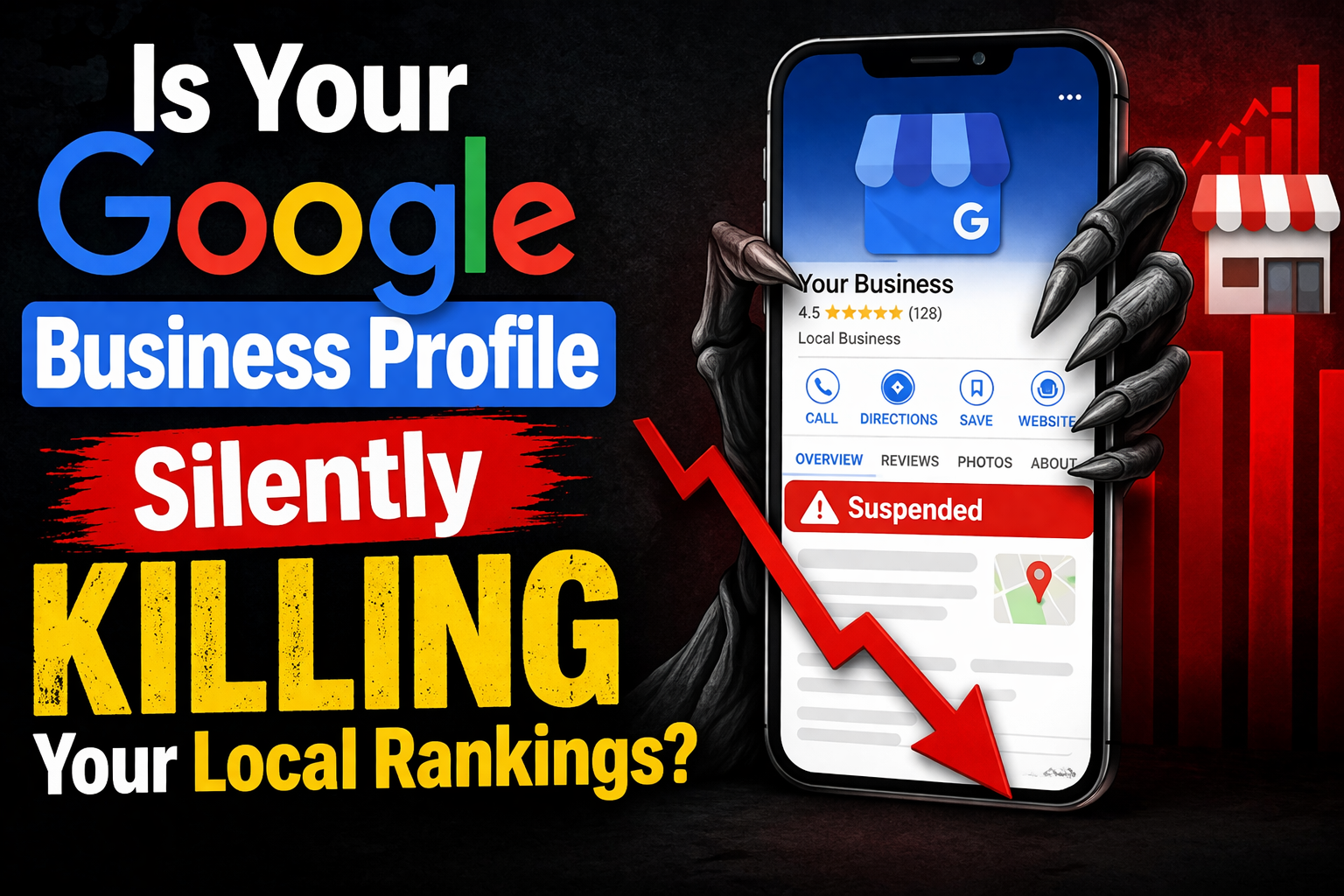
Is Your Google Business Profile Silently Killing Your Local Rankings?

By Gaurav Garg / August 06, 2025
Picture this: You set up your Google Business Profile two years ago. You filled in your name, address, phone number, picked the right category, uploaded a logo, and even collected a handful of glowing reviews. You pressed publish and moved on.
Now fast-forward to today. A competitor down the street — one who opened six months ago — is ranking above you on Google Maps for searches you should own. Their profile looks almost identical to yours. Same category. Similar star rating. Maybe even fewer total reviews.
So what gives?
The answer lies in a fundamental shift in how Google evaluates and ranks local businesses. Your Google Business Profile is no longer a digital business card that you create once and forget. It has evolved into a live, continuously-evaluated engagement platform — and Google rewards businesses that actively work their profiles, not ones that set them up and walk away.
This guide breaks down exactly what’s changed, which signals actually drive local rankings today, and how to build a consistent management system that compounds your visibility over time — including in AI-powered search results that are rapidly reshaping how customers find local businesses.
In the early days of local search, Google Business Profile (formerly Google My Business) functioned much like a digital Yellow Pages listing. Its primary purpose was to confirm that a business existed at a specific location. Google’s local algorithm focused heavily on what’s called NAP consistency — making sure your Name, Address, and Phone number matched across every directory listing on the internet.
Citation matching across platforms like Yelp, Angi, BBB, and local directories was the game. Get your NAP consistent in enough places, choose the right primary business category, and you were in solid shape.
That era is over.
Today, Google uses GBP as an active data collection surface. Every interaction a user has with your profile — a photo view, a click to call, a direction request, a review left, a question asked — is a data point Google captures and weighs. The platform now functions more like a social media feed than a directory listing, and businesses that treat it accordingly are gaining significant visibility advantages over those still playing the old game.
The businesses winning in local search right now are the ones feeding Google a steady stream of fresh signals that say: We are active. We are engaged. We are the right answer for this searcher.
Here’s a concept that’s easy to miss: a stale GBP profile doesn’t just plateau — it actively deteriorates in performance relative to more dynamic competitors.
Think of it like this. Google’s local algorithm is constantly recalibrating which businesses deserve prime map pack placement. Every week that passes without fresh content, new reviews, updated photos, or profile interactions, your profile signals less relevance compared to competitors who are consistently active.
This is especially important in competitive local categories. Consider two dental practices in the same zip code:
Practice B, despite having fewer total reviews and less time in the market, is likely outranking Practice A in the local pack — because Google’s algorithm is now weighting recency and engagement velocity as much as raw numbers.
Static authority, built over years, can be eroded by dynamic activity from newer competitors. This is the new reality of local search.
Most business owners treat their hours as a simple informational field — something to fill in once and revisit if their schedule changes. The data tells a different story.
Current local search research indicates that whether your business is listed as open at the time of a user’s search is a top-five ranking factor for local map pack placement. Businesses listed as open rank measurably better than those listed as closed — even if the searcher doesn’t specifically filter for “open now.”
Real-world example: A plumbing company that keeps their hours updated — including extended weekend hours they offer seasonally — consistently appears in map pack results during Saturday morning searches when homeowners tend to discover leaks and clogs. A competing plumber with the same service area but outdated hours that don’t reflect their weekend availability loses this visibility window entirely.
What this means for you:
Total review count still matters, and a strong star rating absolutely influences click-through behavior. But the pattern and pace at which you earn reviews has become its own signal — one that many businesses completely overlook.
Google’s algorithm interprets a steady stream of recent reviews as evidence that a business is actively operating and consistently serving customers. A business with 200 reviews, all earned between 2019 and 2022, is sending a very different freshness signal than one with 80 reviews earned steadily over the past 12 months.
The math that matters: If you earn 4 reviews per month, that’s 48 new reviews in a year — each one reinforcing to Google that your business is alive, active, and serving customers. That compounding freshness signal is extremely difficult for a competitor with a static review profile to overcome, even if their total count is higher.
Real-world example: A home cleaning service implements a simple post-job text message to every client with a direct link to their GBP review page. They average 8 new reviews per month. A competing service with double their total reviews but no systematic outreach earns maybe 1–2 reviews per month. Within six months, the first service overtakes the second in local rankings — not because they served more customers, but because they built a system.
What this means for you:
On responding to negative reviews: Your public response isn’t for the reviewer — it’s for every potential customer reading it. A calm, professional response to a critical review often builds more trust than 10 five-star reviews. Respond to every complaint with empathy, an acknowledgment of the issue, and an invitation to resolve it offline.
GBP Posts are the feature that almost every local business either completely ignores or uses once in January and abandons. This is one of the most significant untapped opportunities in local SEO right now.
Posting to your GBP profile sends a direct freshness signal — it tells Google’s algorithm that a real person is actively managing this profile. Posts appear directly on your business profile in search results and on Maps, giving you additional real estate and another opportunity to influence searcher behavior before they ever reach your website.
The four post types and when to use each:
Real-world example for a law firm: Many law firms shy away from GBP posts because they don’t think they have “content.” Here’s a week’s worth of post ideas for a personal injury firm: Monday — a brief explanation of what to do immediately after a car accident; Wednesday — an Offer post promoting free consultations through the end of the month; Friday — a staff spotlight on their lead paralegal. None of these require legal expertise to write, and all of them demonstrate to Google that this is an actively managed, authoritative profile.
Real-world example for a home services business: An HVAC company can post weekly around seasonally relevant topics — pre-summer AC tune-up specials in April, furnace inspection reminders in September, emergency heating repair availability in December. Each post is timely, relevant, and directly tied to what searchers in their market are actually looking for.
What this means for you:
The photography strategy that worked three years ago — upload 50 photos once during setup, never touch it again — is now working against you. Verified research on GBP engagement shows that listings with consistently updated, recent photos generate significantly more direction requests, website clicks, and phone calls than those with large but stale photo libraries.
Two separate things are at work here. First, photo upload frequency signals profile activity to Google’s algorithm. Second, authentic, recent photos convert better with actual users because they accurately represent what a customer will experience today, not two years ago.
What “authentic” means in this context:
Real-world example: A med spa that uploads fresh photos twice a month — treatment room setups, staff in action (with permission), before/after results for appropriate services — creates a profile that feels alive and current. A competing med spa with professional photography from their 2021 opening looks polished but dated. Searchers can often sense the difference, and so can Google’s engagement metrics.
What this means for you:
Google has been steadily building GBP into a self-contained transaction surface — a place where a searcher can go from discovery to booked appointment without ever leaving the Google ecosystem. For local businesses, this is both an opportunity and an obligation.
Every feature you enable and actively use tells Google your profile is operational and driving real-world outcomes. Every feature you leave unused or neglected is a missed signal.
The Q&A section: your highest-leverage, lowest-effort opportunity
The Q&A section on your GBP profile is publicly editable, which means anyone — customers, competitors, or random users — can post questions and answer them. The dangerous part: if you don’t seed this section with accurate answers, someone else will.
Take control of your Q&A section by posting the 5–7 questions your customers ask most frequently, and answering them yourself. For a pediatric dental practice, this might include questions about first visit age recommendations, insurance acceptance, sedation dentistry availability, and what to do in a dental emergency. For a roofing company, it might cover insurance claim processes, typical project timelines, warranty terms, and financing options.
Appointment and booking integrations
If your business accepts appointments, connecting a supported booking platform (Google supports integrations with dozens of scheduling tools including Calendly, Booksy, Vagaro, Mindbody, OpenTable, and others) creates a direct engagement loop inside your profile. Users who book through your GBP send a powerful behavioral signal — they converted without ever leaving Google, which is exactly the outcome Google’s algorithm is designed to reward.
Here’s the dimension that transforms everything discussed above from “good practice” into a strategic imperative: Google’s AI-powered search features pull directly from GBP signals.
Google’s AI Overviews and AI Mode — which are now appearing for a growing percentage of local searches — don’t generate their local recommendations from scratch. They synthesize signals from Google Business Profiles, review content, citation authority, and entity consistency to determine which businesses to surface and recommend.
This means the businesses showing up in AI-generated local answers are the ones with:
And the businesses being excluded from AI-generated answers? They’re the ones with stale profiles, incomplete information, sparse reviews, and no posting activity — even if their website is well-optimized and their traditional SEO is solid.
Think of your GBP as AI training data for Google’s local recommendations. Every accurate data point you provide, every fresh signal you send, every piece of authentic content you publish is an input that makes it easier for AI systems to confidently recommend your business when someone asks a relevant local query.
A home services company with a fully dynamic GBP isn’t just winning map pack spots — they’re the ones showing up when someone asks Google’s AI: “Who’s the best HVAC company near me for same-day service?”
A stale profile can’t answer that question confidently. A dynamic one can.
The businesses that win at dynamic GBP management aren’t working harder — they’re working systematically. The goal isn’t to create a second job; it’s to build a repeatable routine that generates compounding results.
Here’s a practical framework:
Google provides profile performance data through the GBP dashboard, and most business owners never look at it. Here’s what to actually track:
Engagement Metrics (Weekly Check)
Visibility Metrics (Monthly Check)
Review Metrics (Monthly Check)
Photo Metrics (Monthly Check)
The goal isn’t to be overwhelmed by data — it’s to identify which activities are driving the most meaningful engagement and double down on them.
Even business owners who are trying to manage their GBP actively often make mistakes that neutralize their effort. Here are the ones that come up most often:
Treating responses as a formality. Copy-pasting “Thanks for your review!” in response to every positive review doesn’t just look lazy — it’s a missed opportunity. Personalized responses that reference specific details from the review are far more effective at building trust with potential customers reading through your reviews.
Ignoring customer-uploaded photos. Users can upload photos to your profile, and they do. Sometimes these are great — authentic, candid shots that build trust. Sometimes they’re outdated, unflattering, or outright wrong. If you’re not monitoring the photos section, you have no idea what’s appearing on your profile.
Letting Q&A go unmonitored. An unanswered question sits on your profile indefinitely. A question with an inaccurate answer from a random user sits there too. Either one erodes trust. Check Q&A weekly.
Posting without a strategy. Publishing a post that says “We’re the best in town! Call us today!” adds nothing of value and generates no engagement. Posts should either provide information (what to look for in a contractor, how to know when your HVAC needs servicing), highlight a genuine offer, or tell a human story about your business. Value first, promotion second.
Selecting the wrong primary category. Your primary business category remains one of the single highest-weighted local ranking factors. If you’re an orthodontist categorized as a “Dentist,” or a med spa categorized as a “Beauty Salon,” you’re leaving significant ranking potential on the table. Audit your primary and secondary categories annually and compare against top-ranking competitors in your market.
Letting hours lapse during holidays. An unverified holiday closure appears to Google as potential business instability. Set special hours for every major holiday in advance — even if your hours aren’t changing. The act of having explicitly set hours signals profile maintenance to Google’s systems.
Here’s the concept that ties everything together and makes consistent GBP management worth the investment: the signals compound.
A business that posts every week for 12 months has built a body of fresh content that signals continuous relevance. Their review velocity creates a trust signal that grows stronger month over month. Their photo library stays current, which keeps engagement metrics elevated. Their complete engagement features drive bookings and calls, which generates more behavioral data for Google to evaluate.
Each of these signals reinforces the others. Higher engagement generates more ranking strength. Better ranking generates more profile views. More profile views generate more reviews, more calls, more direction requests — which further strengthen rankings.
This compounding effect also means that consistently managed profiles become increasingly difficult for competitors to displace. A business that has been actively managing their GBP for two years has built an authority and freshness advantage that a competitor can’t overcome quickly — even with significant short-term effort.
Conversely, a business that has been neglecting their GBP while a competitor has been actively working theirs faces an uphill battle. The competitor’s compounding advantage is real, and it grows with every week of inaction.
The businesses that dominate local search in their categories two years from now are, in many cases, the ones starting to build these systems today.
The most important insight from everything covered in this post is that GBP performance is not static. Every week, Google is reassessing which local businesses deserve prominent placement based on a continuously updated picture of their activity, engagement, and relevance.
A Google Business Profile that isn’t actively managed isn’t holding steady. It’s drifting backward relative to competitors who are earning fresh reviews, publishing regular posts, uploading new photos, and keeping their information accurate and current.
The good news is that most of your competitors are still treating GBP as a set-it-and-forget-it tool. The window to build a meaningful advantage through consistent, systematic GBP management is still open — but it’s narrowing as more businesses wake up to what’s actually driving local rankings.
Start with the basics: audit your hours, respond to every review, post once a week, upload photos on a schedule. Then build from there. The compounding returns begin on day one.
Want a quick-reference guide you can use every week to keep your Google Business Profile working for you? We created a one-page cheatsheet that covers every action item from this post, organized by frequency — weekly, bi-weekly, monthly, and quarterly.
[Download the Free Google Business Profile Optimization Cheatsheet →]
It’s free, printable, and designed to be pinned up wherever you manage your marketing tasks.
Looking for expert help managing your Google Business Profile and local SEO? Contact Entrustech Digital Marketing Agency to learn about our done-for-you local SEO services for healthcare and home service businesses.
No-code platforms allow you to build websites or applications without writing any code, using simple drag-and-drop tools. They are best for beginners and small projects.
Low-code platforms also use visual builders but allow some coding for added customization. This makes them more flexible and suitable for businesses that need more control and advanced features.
No-code platforms provide basic SEO features like meta tags, URLs, and page titles, which are enough for small websites.
However, they may have limitations in advanced SEO areas such as page speed optimization, structured data, and technical control. For competitive SEO, custom development or advanced solutions are usually better.
Startups often choose no-code or low-code because they are faster and more cost-effective. These options help launch products quickly and test ideas without heavy investment.
As the business grows, many startups switch to custom development for better performance, scalability, and long-term growth.
Custom development is best when you need a scalable and high-performance solution with full control over features and design.
It is ideal for businesses that expect growth, require advanced functionality, or want strong SEO performance and better user experience.
Low-code is faster and easier to build, making it suitable for small to medium projects.
Custom development, however, offers complete flexibility, better performance, and higher scalability. For complex or long-term projects, custom development is usually the better choice.
Yes, many businesses start with no-code and later move to custom development as their needs grow.
However, switching may require rebuilding parts of the website, so it is important to plan ahead and ensure your data and SEO structure are properly managed during the transition.
Social media automation is a powerful tool when used with intention and strategy. Automating the right tasks improves efficiency, while keeping interactions human builds trust and loyalty.
WhatsApp us