Your Website Traffic Is Disappearing And Google’s AI Overviews Are the Reason

If your organic website traffic has dropped significantly in the past year, you’re not imagining things. You’re not being penalized. You’re not doing SEO wrong. What’s happening is something far more fundamental and the businesses that understand it now will have a decisive competitive advantage in 2026 and beyond.
Google’s AI Overviews have changed the game. Not incrementally. Radically.
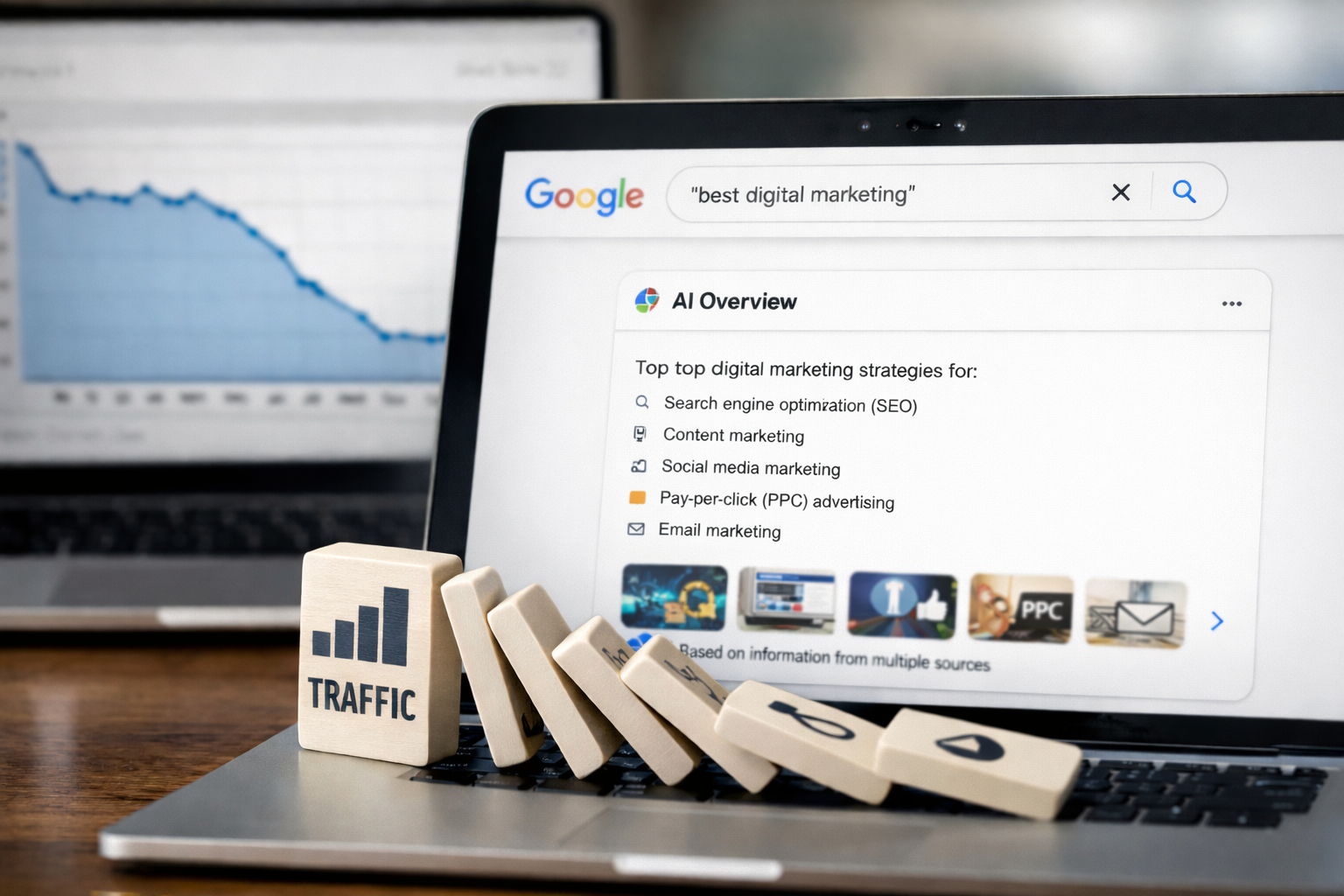
Here’s what the data actually shows: AI Overviews now appear in 58% of all Google searches, up from a mere 12% just two years ago. When an AI Overview appears, the zero-click rate hits 83% meaning more than four out of five users get their answer directly in the search results and never visit your website. For queries processed through Google’s “AI Mode,” that number climbs to 93%.
The consequence? Organic CTRs have dropped 61% since mid-2024. Businesses that spent years building top-ranking content are watching their traffic evaporate not because their content got worse, but because the rules of the game changed entirely.
This article will explain what’s happening, why it matters to your business specifically, and most importantly what you can do about it right now.
Google’s AI Overviews (formerly Search Generative Experience, or SGE) are AI-generated summaries that appear at the top of search results pages. They synthesize information from multiple sources and deliver a complete answer directly in the search results no click required.
The technology draws from across the web, including your content, your competitors’ content, and authoritative third-party sources. Google’s algorithm decides which sources inform the AI-generated response, and those sources may or may not receive a citation link.
For users, it’s convenient. For businesses that depend on organic search traffic, it’s an existential challenge.
Consider the numbers: According to research from Ahrefs, AI Overviews reduce organic CTR for the number-one ranking position by up to 58%. Position one used to be the gold standard in SEO. Now, that coveted top spot may deliver a fraction of the traffic it once did because the AI Overview sits above it.
The situation is especially acute for informational queries “how to,” “what is,” “explain,” “compare” the types of content that have driven organic traffic for years. These are exactly the queries AI Overviews handle most aggressively.
And this isn’t a niche issue. It’s a structural shift across virtually every industry, from professional services to B2B technology to retail. If your audience uses Google (and they do), this affects you.
For years, the standard content marketing playbook worked: research keywords, write comprehensive content, earn rankings, drive traffic, convert visitors. That loop is breaking down.
If 60–80% of queries involving your primary keywords now result in zero clicks, the top-of-funnel traffic that once fed your sales pipeline is drying up. Blog posts that once delivered thousands of monthly visitors may now deliver hundreds not because they lost rank, but because fewer people are clicking through at all.
This doesn’t mean content marketing is dead. It means the old metrics (traffic, rankings) can no longer be the primary indicators of content success. The businesses feeling the most pain right now are those still measuring content solely by organic sessions.
Here’s the deeper problem: if your brand isn’t being cited or referenced in AI-generated summaries, you are effectively invisible to a growing percentage of searchers. Those users are getting answers they’re just not getting them from you.
Establishing a presence in the AI layer being the source Google’s AI cites, references, or recommends requires a different kind of authority than traditional SEO. It requires structured, credible, expert-level content. It requires entity recognition (Google knowing who your brand is and what you stand for). It requires a body of work that AI systems can trust.
Mid-size companies that haven’t invested in thought leadership or brand-building content are the most exposed here. If Google’s AI doesn’t know who you are, it won’t cite you.
As organic traffic declines, many businesses are reflexively shifting budget toward paid search. That’s not inherently wrong but it’s expensive if done reactively and without strategy. CPCs continue to rise, and competition for paid placements intensifies precisely because organic is getting squeezed.
The businesses that respond to zero-click search by simply increasing ad spend, without addressing the underlying visibility problem, will find themselves in a cost spiral. The smarter move is to build a multi-channel presence that doesn’t depend on any single traffic source.
The new currency in SEO isn’t rank position it’s being cited by AI. To earn that, your content needs to be structured for machine readability and demonstrate unmistakable expertise.
Practically, this means: using clear headers and structured formatting, answering questions directly and concisely before expanding, incorporating original data or research (AI systems prioritize novel insights), citing credible sources, and maintaining author expertise signals (bios, credentials, LinkedIn linkage).
Content that’s vague, generic, or thin is invisible to AI systems. Content that is precise, well-structured, and genuinely expert has a chance of earning citation which, in a zero-click world, may deliver more brand exposure than a traditional click-through ever did.
This is the most important strategic shift: stop treating organic Google search as your primary or sole digital distribution channel. The businesses winning in 2026 are building presence across multiple platforms simultaneously.
That means YouTube (AI systems increasingly cite and reference video transcripts), LinkedIn (especially for B2B audiences direct reach without algorithmic gatekeeping), email newsletters (owned audience, zero platform dependency), industry publications and PR (third-party mentions and citations build authority AI systems recognize), and community platforms like Reddit (AI frequently surfaces Reddit discussions in responses).
The goal is to be discoverable wherever your audience seeks information not just on Google.
Informational queries (“what is” / “how to”) are where AI Overviews dominate most aggressively. Commercial and transactional queries (“best [product] for [need],” “[vendor] vs [vendor],” “hire [service provider”) still drive meaningful click-through, because users making purchasing decisions want to evaluate options themselves.
Redirecting content investment toward mid-funnel and bottom-funnel content comparison pages, case studies, pricing guides, decision frameworks is one of the highest-ROI moves a mid-size business can make right now. This content serves buyers who are already convinced they need a solution; they just need to choose.
If you’re still measuring content performance purely by organic sessions and rankings, you’re flying blind. The metrics that matter in 2026 are: Share of Voice (how often your brand appears in SERPs relative to competitors, across all placements), AI Citation Frequency (how often your content or brand is referenced in AI-generated responses), Brand Search Volume (are people searching for you by name?), and Multi-touch Attribution (what’s actually driving leads and revenue across all channels?).
Tools are evolving rapidly to help track AI visibility. Platforms like Semrush, BrightEdge, and Authoritas are all rolling out AI Overview tracking capabilities. This is now a core SEO metric, not a nice-to-have.
At Entrustech, we’ve spent years helping CTOs, IT directors, and marketing managers at mid-size companies build digital marketing infrastructure that doesn’t depend on a single channel or algorithm. The zero-click revolution isn’t a crisis for businesses with the right foundation it’s a competitive advantage.
We help clients audit their current organic traffic exposure, restructure content for AI citation eligibility, build multi-channel distribution strategies that reduce Google dependency, and implement attribution frameworks that track what actually drives revenue.
If your organic traffic has dropped and you’re not sure what to do next, let’s talk. The window to get ahead of this shift is now before your competitors do.
No-code platforms allow you to build websites or applications without writing any code, using simple drag-and-drop tools. They are best for beginners and small projects.
Low-code platforms also use visual builders but allow some coding for added customization. This makes them more flexible and suitable for businesses that need more control and advanced features.
No-code platforms provide basic SEO features like meta tags, URLs, and page titles, which are enough for small websites.
However, they may have limitations in advanced SEO areas such as page speed optimization, structured data, and technical control. For competitive SEO, custom development or advanced solutions are usually better.
Startups often choose no-code or low-code because they are faster and more cost-effective. These options help launch products quickly and test ideas without heavy investment.
As the business grows, many startups switch to custom development for better performance, scalability, and long-term growth.
Custom development is best when you need a scalable and high-performance solution with full control over features and design.
It is ideal for businesses that expect growth, require advanced functionality, or want strong SEO performance and better user experience.
Low-code is faster and easier to build, making it suitable for small to medium projects.
Custom development, however, offers complete flexibility, better performance, and higher scalability. For complex or long-term projects, custom development is usually the better choice.
Yes, many businesses start with no-code and later move to custom development as their needs grow.
However, switching may require rebuilding parts of the website, so it is important to plan ahead and ensure your data and SEO structure are properly managed during the transition.
Social media automation is a powerful tool when used with intention and strategy. Automating the right tasks improves efficiency, while keeping interactions human builds trust and loyalty.
WhatsApp us