The Local Geo-Grid Playbook: Dominate Google Maps & Voice Search for Businesses

Picture this: You sit down at your office desk, open Google, and search for your primary service whether that is “commercial HVAC repair,” “urgent care clinic,” or “digital marketing agency near me.” You see your business sitting proudly at the top of the Google Maps 3-Pack. You celebrate, assuming your local SEO strategy is completely locked down.
Then, you drive two miles down the road, pull over at a red light, run the exact same search on your phone, and discover something alarming: your business has vanished from the top three results entirely, replaced by competitors you did not even know existed.
Welcome to the reality of modern local search.
Google does not evaluate local businesses on a flat, city-wide scale. Because of proximity decay, hyper-local algorithmic signals, and AI-driven search models, your business ranking changes literally block by block. If you are relying on standard keyword rank trackers that report a single “city rank,” you are looking at an incomplete picture.
To capture high-intent customers in your market, you need to understand and master Geo-Grid Tracking, Google Maps Algorithmic Pillars, and Voice Search Optimization.
Here is your comprehensive playbook for diagnosing your real physical visibility, dominating local maps, and ensuring AI voice assistants recommend your business first.
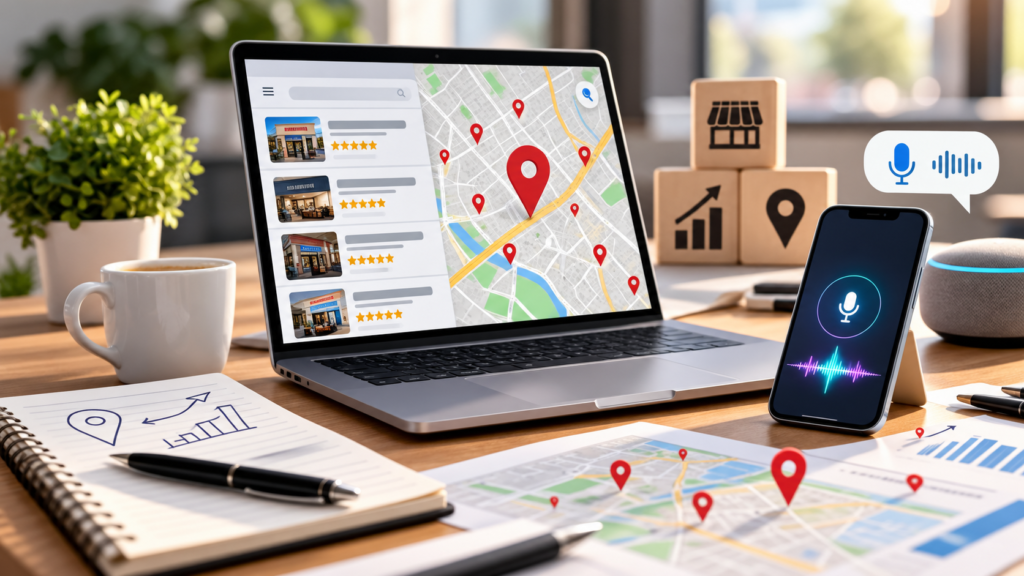
Traditional rank trackers test your website from a single static IP address or data center. They give you a single number, for example, “You rank #2 for Plumber in Austin.”
However, when a real person searches for a service on their mobile device, Google uses their precise device GPS coordinates. A user standing 0.5 miles from your front door will see completely different map results than a user standing 3 miles away.
Geo-Grid tracking solves this visibility blind spot by placing a virtual map grid typically a 5×5, 7×7, or 9×9 matrix of GPS data points over your service territory.
At every single node on that grid, automated scans test where your Google Business Profile (GBP) ranks for your target keywords. The result is a color-coded heatmap:
By visualizing your rankings across an actual geographic grid, you can immediately spot where your visibility drops off. If your green nodes abruptly turn red two miles north, you know exactly where you need to focus your localized link building, review velocity, and location-page signals.
Google filters every local business through three core algorithmic pillars before deciding who gets featured in the Maps 3-Pack: Relevance, Distance, and Prominence.
Understanding how to optimize for each pillar is the key to expanding your green Geo-Grid footprint.
Relevance measures how closely your online entity matches what the searcher is asking for.
Distance calculates how far physical searchers are from your business location or defined service area. While you cannot physically move your building closer to every customer, you can strengthen your digital proximity signals:
Prominence reflects how well-known, trusted, and reputable your business is across the web. Prominence is what allows a top-tier business 3 miles away to outrank a low-quality competitor standing 0.5 miles away.
Voice search is no longer a futuristic novelty; it is a primary driver of local discovery. Whether someone uses Siri while driving, asks Google Assistant from their smartwatch, or uses ChatGPT Voice mode at home, voice queries behave very differently from typed text searches.
Typed Search vs. Spoken Voice Search.
When users speak a query, they expect a single, authoritative direct answer not a page full of links to browse. To become the business that AI assistants read aloud, you must optimize for Answer Engine Optimization (AEO).
If your business is currently surrounded by red and yellow nodes on local Geo-Grid scans, here is a practical 90-day action plan to systematically expand your green territory:
Month 1: Diagnostic Audit & Profile Optimization
Month 2: On-Page Localization & Schema Deployment
Month 3: Review Automation & Local Authority Building
Managing local SEO, tracking Geo-Grid heatmaps, configuring server-side schema, and keeping up with weekly Google algorithm shifts is a full-time technical job. For busy healthcare providers, home service operators, and business leaders, trying to run local SEO internally often leads to wasted ad spend and missed opportunities.
At Entrustech Inc., we take the entire burden off your shoulders.
As a full-service, “done-for-you” digital marketing agency, we combine advanced Geo-Grid tracking, technical SEO, high-converting web design, and custom campaign management into a single seamless growth engine. We do not just show you pretty vanity charts, we focus strictly on expanding your local footprint, increasing high-intent phone calls, and driving measurable revenue growth for your business.
Your ranking radius depends heavily on population density, local competition, and your domain prominence. In dense urban areas, top 3-Pack visibility might extend 1 to 3 miles. In suburban or rural areas, strong entity prominence can extend your green radius 5 to 15 miles out. Building strong review velocity and hyper-local backlinks helps expand your reach further from your physical address.
Voice searches rely heavily on natural, conversational language and physical location data. When someone asks Siri or Google Assistant for a local service, the AI typically reads aloud only the top result from Google Maps or Apple Maps. If your business is not optimized for local schema, conversational Q&A keywords, and top-3 map rankings, you lose out on voice-driven conversions entirely.
We recommend running Geo-Grid scans on a monthly or bi-weekly basis. Regular scanning allows you to spot algorithmic updates immediately, track the expansion of your green visibility radius as optimizations take effect, and detect aggressive move-ins by local competitors before they impact your incoming lead volume.
WhatsApp us