The Death of the “Contact Us” Page: Why Frictionless Self-Serve Funnels Are Outconverting Phone Calls 3-to-1

Think about the last time you wanted to book a service or evaluate a B2B partner. You spent twenty minutes browsing a website, liked what you saw, and decided to take the next step.
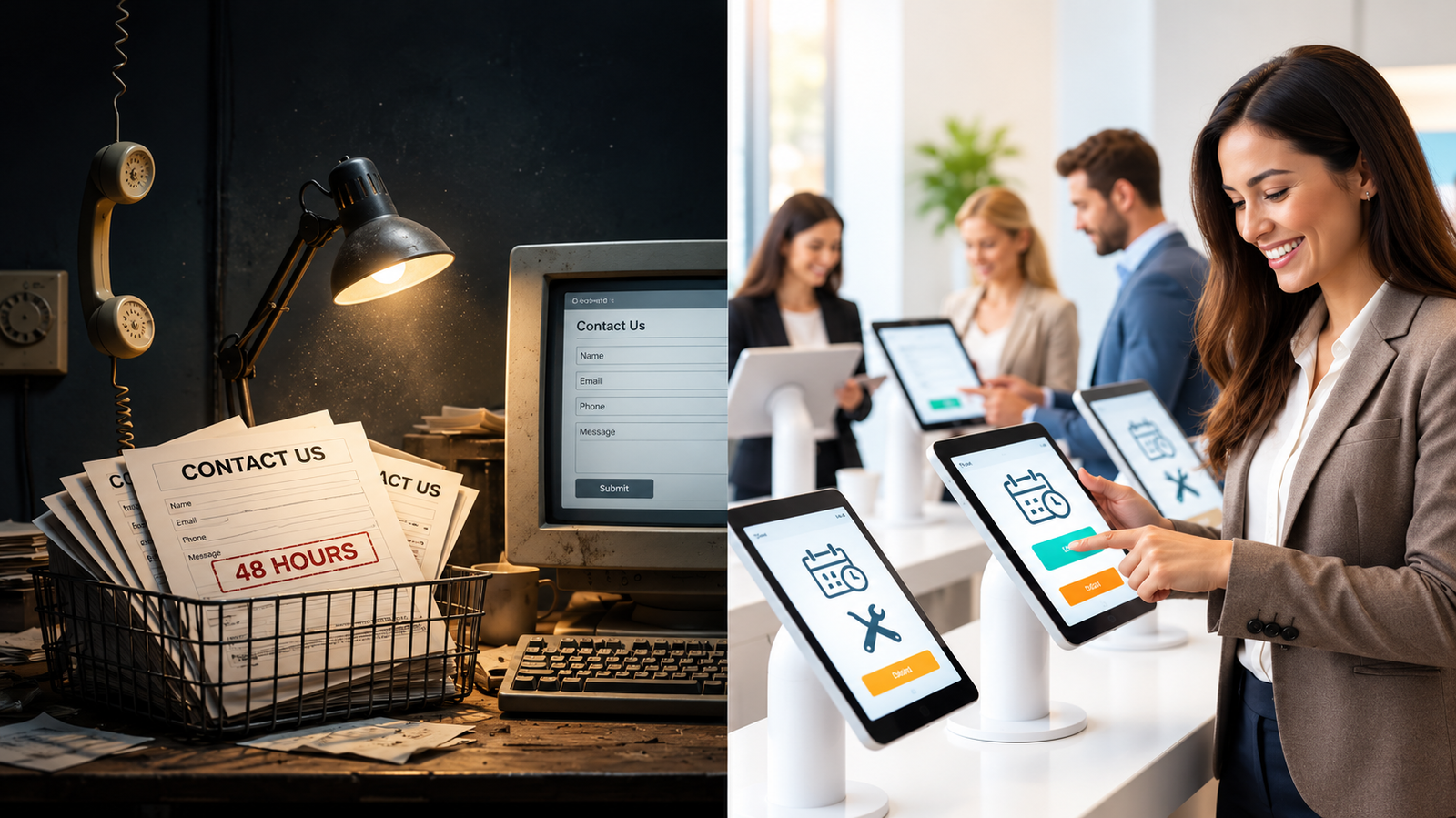
You clicked on the “Contact Us” button in the top menu. What greeted you?
A blank, sterile form asking for your full name, email, phone number, company size, physical address, and a big open text box labeled “How can we help you?”
Below that form sat a passive line of text: “A representative will get back to you within 24 to 48 business hours.”
How did that make you feel? If you are like 80% of modern consumers and business buyers, you felt a wave of friction. You knew that submitting that form meant entering an informational black hole. Best case scenario? You wait two days for a generic template email. Worst case scenario? Your phone number gets added to an aggressive sales dialer, resulting in five unwanted phone calls while you are in the middle of a workday.
So, what did you do instead? You hit the back button on your browser and found a competitor whose site allowed you to get an instant estimate, select your exact problem, or book an appointment directly on their calendar in under sixty seconds.
The traditional “Contact Us” page is officially dead. It was built for a 2010 internet where buyers had limited access to information and were forced to speak with a gatekeeper. Today’s buyers demand control, speed, and complete transparency.
At Entrustech Inc., we have tracked this shift across hundreds of digital marketing campaigns. Across local home services, healthcare practices, and B2B firms, businesses replacing passive contact pages with frictionless self-serve funnels are seeing conversion rates increase by as much as 300%.
Here is a deep dive into why buyer behavior has fundamentally changed, how frictionless self-serve funnels work, and how you can replace your dead contact page with a high-yield client acquisition engine.
To understand why traditional contact pages fail, you have to understand the psychological state of today’s buyer.
Whether a homeowner is dealing with a broken air conditioner at 9:00 PM, a patient is researching specialized dental care during their lunch break, or a marketing director is evaluating agency partners between executive meetings, modern buyers share three universal traits:
Buyers do not want to “hop on a quick 15-minute discovery call” just to learn basic information you should have provided on your website. They view forced sales calls as an unnecessary tax on their time. If your website forces them to jump through hoops just to get preliminary answers, they will switch to a competitor who respects their time.
When a site hides its pricing or service ranges behind a generic “Contact For Quote” form, buyers immediately suspect two things: either your services are wildly overpriced, or your sales team is going to subject them to high-pressure closing tactics. Transparency builds immediate trust; opacity breeds skepticism.
Modern buyers want to diagnose their own problems. They want to click through interactive options, evaluate choices that fit their specific budget and timeline, and feel like they are in complete command of the purchasing process.
When you force a modern buyer onto a generic “Contact Us” form, you create immense friction. When you replace that form with an interactive, self-serve funnel, you remove every barrier standing between their immediate problem and your solution.
A frictionless self-serve funnel is an interactive, guided web experience that allows prospects to self-qualify, explore solutions, estimate costs, and schedule their own next steps all without needing to speak to a gatekeeper first.
Instead of staring at a blank text box and wondering what to write, the prospect is guided through a series of intuitive visual micro-steps that collect rich zero-party data while delivering instant value.
Here are the four essential pillars of a high-converting self-serve funnel:
Price is almost always the number one question in a buyer’s mind. While you may not be able to give a final binding quote online for complex services, you can provide dynamic price ranges based on user inputs.
An interactive cost estimator allows visitors to select their parameters such as square footage, project scope, or practice size and receive an instant estimated budget range on screen. In exchange for the detailed estimate breakdown sent to their inbox, visitors happily provide their verified contact details.
Rather than listing twenty technical service offerings on a static page, a diagnostic funnel asks simple, visual questions:
As the user clicks through these choices, the funnel dynamically tailors the recommendation on the final screen, showing them the exact service package or treatment plan that fits their situation.
If a prospect decides they want to talk to your team, do not make them fill out a form and wait for a callback. Embed live calendar booking tools directly into the final step of your funnel.
By integrating tools that sync directly with your team’s real-time availability, high-intent prospects can select a date and time slot that works for them, turning a cold website visit into a confirmed appointment in seconds.
For B2B brands and professional service providers, self-serve funnels can generate preliminary audits or custom proposals automatically. By inputting their website URL, industry, and main goals, prospects receive an automated 5-page preliminary diagnostic report within two minutes, establishing your brand as an immediate authority before the first conversation even happens.
When business owners consider replacing their traditional contact page, their biggest worry is often: “If we don’t force people to call us, won’t we lose leads?”
The campaign data tells the exact opposite story. When we audit conversion performance across client websites, the numbers consistently favor self-serve architecture:
Traditional static contact pages average a conversion rate of 2% to 5%. Interactive self-serve funnels regularly achieve conversion rates between 8% and 15%. Because answering a simple visual question requires far less mental effort than composing a custom message, visitors enter the funnel effortlessly.
When a prospect reaches your sales or intake team through a self-serve funnel, they are already educated. They have selected their preferences, viewed preliminary pricing ranges, and reviewed relevant case studies. The initial sales conversation shifts from an awkward, surface-level discovery call to a focused strategy session, cutting sales cycle lengths in half.
Generic contact forms yield generic inquiries like “How much do you charge?” Self-serve funnels capture deep, structured zero-party data including exact budgets, specific pain points, project urgency, and decision-making timelines. Your sales team receives a complete dossier on the prospect before ever picking up the phone.
Transitioning away from a dead “Contact Us” page doesn’t mean deleting your contact info entirely. It means restructuring how users interact with your brand online.
Follow this step-by-step roadmap to upgrade your site structure over the next 30 days:
Look at your current website analytics. How many people visit your contact page, and what percentage actually fill out the form? Inspect the inquiries you receive. If half of them are unqualified spam or tire-kickers asking basic questions, your current form is failing both your visitors and your sales team.
Identify the primary reasons clients hire you. Group these into three distinct categories based on urgency, scope, and budget. These three categories will form the core options of your interactive diagnostic selector.
Design a simple, high-speed multi-step form:
Ensure that every completed self-serve flow triggers an instant SMS confirmation, sends a tailored resource PDF based on their selections, and creates an enriched lead profile inside your CRM.
Designing, coding, and optimizing a frictionless self-serve funnel requires a multidisciplinary skill set. You need user experience (UX) designers who understand conversion psychology, copywriters who write persuasive micro-copy, web developers who code fast-loading interactive elements, and analytics specialists who connect conversion APIs to your ad accounts.
Attempting to piece this together using off-the-shelf plugins or managing multiple freelancers often results in broken code, slow loading speeds, and disjointed brand messaging.
At Entrustech Inc., we handle the entire process for you.
As a full-service, “done-for-you” digital marketing agency, we build high-converting client acquisition engines backed by targeted Google Ads, precision local SEO, and custom web architecture. We replace outdated, low-performing web pages with custom self-serve funnels engineered to maximize your return on ad spend and deliver a steady stream of pre-qualified, booked clients.
We take the technical and creative burden entirely off your shoulders so you can focus on what you do best: running your business.
Yes, absolutely. In fact, self-serve funnels work exceptionally well for custom-scoped services. You do not need to give an exact, binding quote inside the funnel. Instead, you can provide dynamic estimated budget ranges based on the parameters the user selects (e.g., "Projects with these specifications typically range between $2,500 and $4,000"). This establishes price expectations early and filters out unqualified leads who lack the budget for your services.
No. The goal of a self-serve funnel is not to eliminate human interaction, but to eliminate unnecessary friction prior to that interaction. The funnel pre-qualifies, educates, and warms up the prospect so that when they do book a phone call or in-person consultation, they are already eager to work with you and ready to buy.
Modern self-serve funnels are built using open API architectures. They connect directly to popular CRMs (such as HubSpot, Salesforce, or HighLevel) and scheduling applications (like Calendly or Google Calendar). When a prospect completes a funnel, their selected data, quiz answers, and contact information automatically populate inside your CRM before triggering instant automated follow-up sequences.
A high-converting self-serve funnel always includes a persistent "Click-to-Call" option alongside the interactive steps. By offering both a 60-second self-serve pathway and a direct phone connection, you cater to both tech-savvy users who want instant online booking and traditional users who prefer speaking directly to a representative.
When built correctly using lightweight, modern JavaScript frameworks, self-serve funnels load almost instantly and are fully optimized for mobile screens. Because over 65% of local service and B2B web searches occur on mobile devices, self-serve funnels are designed around thumb-friendly selection cards and simple tap interfaces, delivering a vastly superior mobile experience compared to traditional long-form pages.
Generic DIY quiz software platforms often load slow third-party scripts that harm your site’s Google SEO rankings, feature clunky non-customizable branding, and fail to integrate cleanly with your Google Ads or Meta tracking tags. Entrustech designs, codes, and optimizes bespoke conversion funnels tailored directly to your brand voice, fully integrated with your tracking stack, and supported by our complete team of digital growth specialists.
WhatsApp us